
Botswana is one of the
few countries, which has been blessed with a number of different wildlife
species, which also contribute as a major tourist attraction. The Department
of Wildlife and National Parks is charged with the responsibility of monitoring,
managing and protecting wildlife as a national asset.
Wildlife species are found in protected areas such as Game Reserves and
National Parks while others are found outside these areas in Controlled
Hunting Areas. Wildlife species found in Botswana include the elephant,
giraffe, lion, hippopotamus, buffalo etc.
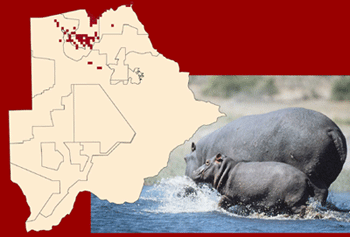
Hippopotamus Distribution
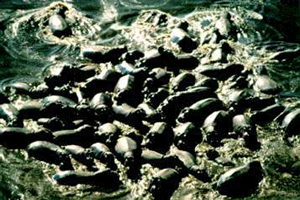
Hippopotamus on the Chobe river
Tourism plays an important role in the economy of the country as it is ranked amongst the top five of the highest revenue earners. The country is also ranked eleventh among the top twenty African destinations in terms of earnings. Tourism currently relies on wildlife, which is more concentrated in Game Reserves and other Wildlife Management Areas in northern and western Botswana. Apart from wildlife there are other tourist attractions like natural historical sites, the Tsodilo Hills which are famous for their rock paintings and the Okavango Delta. The delta has all its natural beauty as it has different animal and bird species.
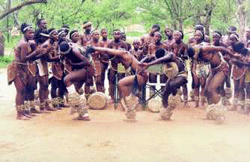
Young Traditional Dancers
Safari Vehicles in Makgadikgadi Salt Pans
The
2001 population census gives the population of Botswana at approximately
1.7 million. However the chapter covers population estimates from pre–independence
era to present with elaborate statistics from the country’s three
(3) census years. It outlines all the characteristics of population density
for internal and external migration. Most importantly, it shows how levels
of both fertility and mortality have affected the country’s population
growth rate.
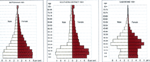
Population growth

Teenage Migrants to Towns
Chapter 18:
EDUCATION AND TRAINING
Education goes back to
the days before Christianity, which was imparted through the medium of
schools and other institutions. There was a type of formal education called
bojale for girls and bogwera for boys. Later missionaries came and started
schools in order to enable the people to read the Bible. Since independence
great development has occurred, now the country has several primary, secondary
and tertiary institutions.
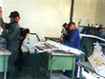
Trainees at a Vocational Training Center
Botswana’s health policy has produced enviable results, placing the country well above most other countries in the Southern African Development Community (SADC) region. However, like most developing nations in the tropical and subtropical regions, Botswana has to contend with various infections and parasitic diseases. Some of these diseases like AIDS, TB etc appear to be on the upsurge, therefore the challenge for the nation is to sustain the fight against these diseases as cost effectively as possible.
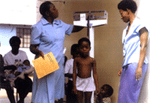
Community health Center
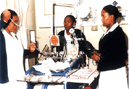
Nurses at Princess Marina Hospital
Chapter 20:
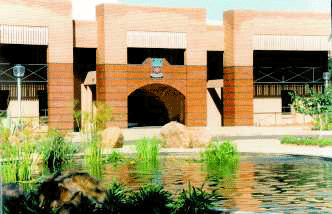
There have been remarkable changes in the country's developmental and financial situation since independence. Whilst Botswana was amongst the poorest countries at Independence in 1966, it is now a middle-income country, which is characterised by prudent financial management and development planning. It is often cited as one of the success stories of developing countries, especially in Africa.

Bank of Botswana
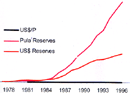
Foreign Reserves
Chapter 21: COMMERCE AND INDUSTRY
Commerce and Industry
are significant sectors to Botswana’s national development because
of their contribution to the country’s economic independence, economic
diversification, employment creation, and transfer of technical and entrepreneurial
skills and technology.
Commerce refers to all those activities involved in the transfer of goods
from producers to consumers and focuses mainly on internal and external
trade. On the other hand industry encompasses mining, construction, the
provision of utilities such as water, electricity and gas.
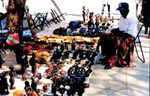
A man displaying handicrafts
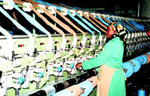
Textile Industry
Chapter 22: TRANSPORT AND COMMUNICATION
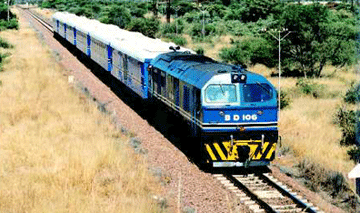
Countrywide transport
and communication networking is a prerequisite for development. The movement
and exchange of goods, services and information are not possible without
good roads, telecommunications etc. At independence Botswana had only
twelve kilometers of tarred road, but tremendous development has taken
place since then.

Chapter 23: INTERNATIONAL RELATIONS
Through international
relations, the country is able to relate to other nations. The Ministry
of Foreign Affairs is assigned the responsibility of formulating and implementing
foreign policy, and this guides government in dealing with foreign countries
and international organisations. This foreign policy is based on four
national principles of democracy, development, self-reliance and unity.
Botswana is a member of different organisations such as the African Union,
Southern African Development Community, the United Nations, Southern African
Customs Union etc.
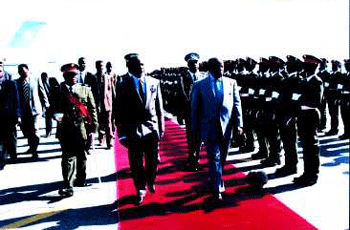
President Festus Mogae in Mozambique
Botswana is a member of SADC
Chapter 24: CULTURE AND HERITAGE
Culture is a way of life of a nation and relates to their languages, religious experiences and generally to the way they conduct their lives. It is all the learned experiences that people inherit from generation to generation. The chapter deals with most of the historic sites of Botswana and further outlines how the country is preserving the cultural heritage among others.
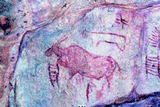
Paintings at Tsodilo Hills
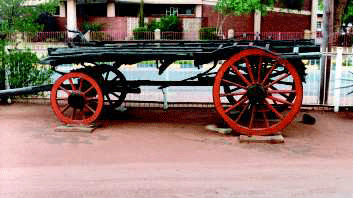
Display at the national museum
Chapter 25: DEMOCRACY, GOVERNANCE AND POLITICS
Before Independence a form of governance prevailed in the Tswana society with the kgotla as the main core. In each community there were various kgotlas hierarchically organised with the kgosi’s kgotla being the central one. Below this were a number of wards (dikgotla). The Kgotla was an institution served as a forum for policy formulation, decisions including political and economic developmental activities and judiciary on litigations. Advisers mostly from royal relatives assisted the chiefs of the kgotla. These institutions still play a vital role in the present form of government.
A Traditional Kgotla

Chapter 26: LAW, JUSTICE AND SECURITY
Botswana has a dual legal System based on the Roman Dutch Law and the Customary Law. These laws are made by Parliament, the administration and enforcement of the law is carried out through the Administration of Justice, Attorney General and security forces

High Court in Session
BDF Anti-Poaching Unit
Chapter 27:
WOMEN IN DEVELOPMENT
Since independence in
1966, the Botswana Government has initiated several programs aimed at
assisting women. The International Women’s Year first decade (1975
-1985) marked the first systematic and international effort to redress
gender inequalities in development. It was characterised by efforts to
integrate women into development processes through promotion of equal
participation in the socio-economic activities.
The Beijing Platform for Action (PFA) calls upon governments, amongst
others to take strategic action in twelve critical areas of concern identified
within the PFA documents as priority national issues, out of these twelve
the Government of Botswana has identified six as critical issues.
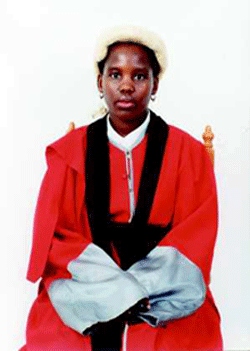
First woman judge
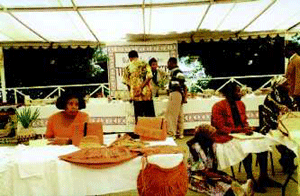
Women at a Local Exhibition Centre
Chapter 28: YOUTH AND NATIONAL
DEVELOPMENT
Botswana is characterised by a youthful population, about 60 – 70% according to the 1991 Population and Housing Census. In most countries, issues that affect young people are unemployment, health, education and training, talent development, culture, sports, leisure and recreation, youth crime and violence. Government is therefore faced with the challenge of addressing these concerns and to ensure that young people are prepared to contribute to the development of the country.
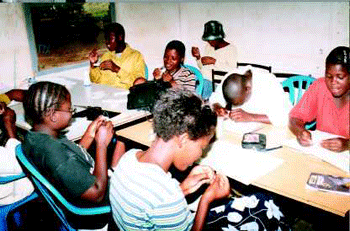

Local Talent in Music
Chapter 29: THE OKAVANGO DELTA
The Okavango Delta measuring
about 12000 kilometres is situated in North Western Botswana. It is quite
remarkable that a wetland of its size should occur in a generally semi-arid
environment, and this has partially contributed to its character and beauty.
The unique beauty of the Okavango Delta and its vast wildlife resources
has resulted in the development of the rapid growth of the tourist industry,
which has created employment opportunities for local citizens.
The Okavango Delta consists of two distinct regions, the upper linear
panhandle section and the lower delta shaped alluvial fan. Within these,
they are permanent and seasonal swamps, which are characterised by a number
of large lakes.
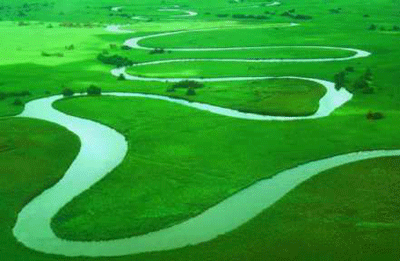
The Okavango Delta